

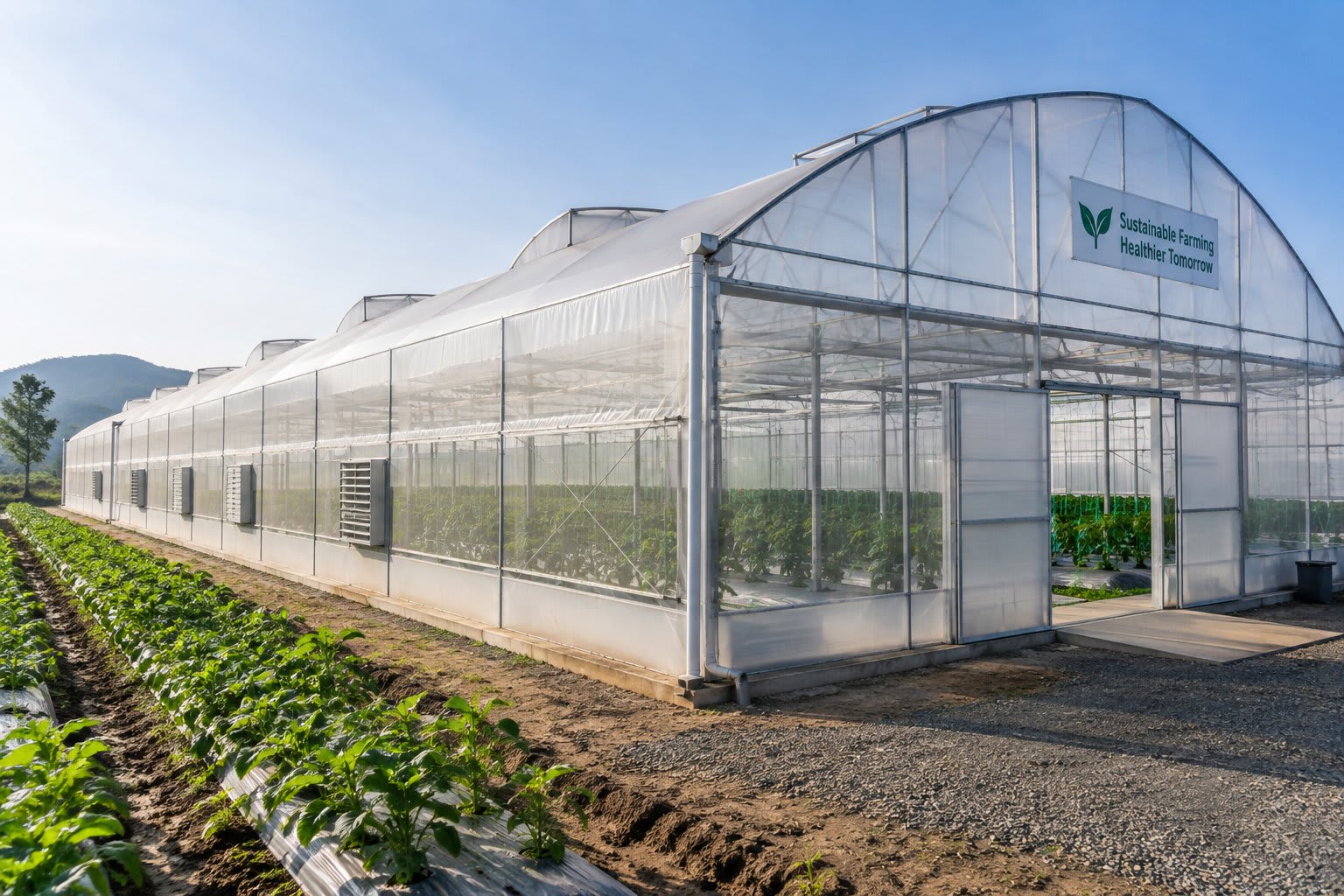
Natural Ventilated Polyhouse
Natural Ventilated Polyhouse (NVPH) is a widely used agriculture greenhouse structure that regulates the internal growing climate purely through natural air movement — side and top/ridge ventilation — without depending on electrically powered fans or pads. It is one of the most practical and cost-effective polyhouse designs for round-the-year protected cultivation.
Key Features
Ridge/top ventilation combined with side ventilation for continuous natural air exchange
No electricity or fan dependency for cooling and air circulation
Strong GI pipe/truss framework built to standard specifications
UV-stabilized polyethylene film covering
Insect-proof netting fitted on all ventilation openings
Drip irrigation and fertigation compatible
Roll-up or fixed side curtains for climate adjustment
Available in customized spans and gutter heights according to land and crop requirements
Benefits of Natural Ventilated Polyhouse
Creates a stable natural microclimate without running/operational costs
Low power consumption compared to fan-and-pad systems
Can be built to standard specifications commonly required for horticulture subsidy schemes
Helps improve crop quality and uniformity
Reduces pest and insect entry through insect-proof netting
Efficient use of water through drip irrigation and fertigation
Durable, low-maintenance structure suitable for long-term use
Suitable for small, medium and commercial farming projects
Suitable Crops
Natural Ventilated Polyhouse is commonly suitable for:
Tomato
Capsicum
Cucumber
Exotic Vegetables
Cut Flowers (Rose, Gerbera, Carnation)
Nursery Plants and seedling raising
Crop suitability depends on the local climate, cultivation method and market requirements.
Natural Ventilated Polyhouse Structure
A typical Natural Ventilated Polyhouse consists of:
Sr. No. | Component |
|---|---|
1 | GI tubular/truss structure |
2 | UV-stabilized poly film covering |
3 | Top/ridge ventilation system |
4 | Side ventilation with insect-proof net |
5 | Entry door |
6 | Drip irrigation system |
7 | Fertigation system |
8 | Crop support system |
9 | Required greenhouse accessories and fixtures |
Natural Ventilated Polyhouse Design
The design and dimensions of a Natural Ventilated Polyhouse should be selected according to:
Available land area
Crop type and height
Local wind and climate conditions
Required ventilation percentage
Irrigation requirements
Covering material
Farming budget
A properly engineered, site-specific design helps ensure optimal ventilation, structural strength and long-term performance.
Natural Ventilated Polyhouse Cost
The cost of a Natural Ventilated Polyhouse depends on its span and gutter height, structural material, covering film, ventilation percentage, irrigation, fertigation, crop-support system, installation and site conditions.
For an accurate price, the project should be evaluated according to the required area and specifications.
Why Choose Rudra Enterprises for Your Natural Ventilated Polyhouse?
As an experienced greenhouse manufacturer and greenhouse supplier, Rudra Enterprises delivers a complete greenhouse construction service — from site survey and design to structure fabrication, covering, ventilation, irrigation and installation.
For a complete Natural Ventilated Polyhouse project, proper design, quality materials and professional installation are important for reliable long-term performance.
Interested in this structure?
Share your land dimensions and we'll get back with a structural recommendation and quotation.